Explore the future of gold and silver investment in the Middle East. Learn how geopolitical tensions, inflation & investor demand shape precious metals markets.

One thing that investors have learnt in the past few years is that "certainty is expensive".
Markets change. Policies shift. Headlines arrive faster than people can process them. Still there is one question that keeps coming up: "what's in store for gold in the Middle East and silver Middle East investment opportunities"?
As we step into 2026, investors from the UAE and Middle East are experiencing changes in economic signals, trends in commodity, and most importantly, geopolitics. Some are looking for protection. While some are looking for growth. There are people who are giving preference to stability.
And that's exactly why gold and silver continue to matter.
The story isn't just about the gold price anymore.
It's about how multiple forces are colliding at the same time. Traditional investment assumptions are being questioned as a result of the increase in inflation, changes in interest rates, trade routes, and geopolitical developments.
Discussions about regional growth and economic diversification are still going strong throughout the Middle East. However, external variables are also being considered by investors. Sentiment is still shaped by the interplay of oil prices, financial markets, and global growth.
The appeal of precious metals investment hasn't changed much over centuries.
When uncertainty grows, people naturally look toward assets that have survived economic cycles, political shifts, and currency fluctuations. Gold has long been viewed as a safe-haven asset and a reliable store of value. Silver, meanwhile, offers a unique blend of investment demand and industrial utility.
For many investors, precious metals aren't about replacing other investments. They're about balance.
A diversified portfolio may include:
This approach creates diversification across different asset classes. This helps investors navigate periods when equity markets or other sectors experience a downturn.
The connection between precious metals and global events is nothing new.
Whenever geopolitical tensions increase, markets tend to react quickly. We've seen this pattern repeatedly throughout history.
In recent years, developments involving Iran, regional security concerns, and wider geopolitical conflicts have reminded investors how quickly sentiment can change. Even discussions around the Strait of Hormuz can influence energy markets and investor behaviour.
If a conflict in the Middle East were to intensify or if middle east tensions continue to escalate, investors often move toward traditional safe havens. This creates additional safe-haven demand that can affect gold and silver prices.
Markets don't respond only to events. They respond to expectations, reactions, and perceived risk.
That's why analysts frequently monitor:
| Market Factor | Potential Impact |
| Regional security concerns | Increased demand for safe-haven assets |
| Rising crude oil prices | Higher inflation expectations |
| Currency fluctuations | Increased interest in hedging strategies |
| Global uncertainty | Stronger precious metal demand |
A potential war in the Middle East isn't anyone's desired outcome, but markets always attempt to price risk before it materialises.
Few regions influence global energy markets like the Middle East.
When crude oil and Brent crude prices move sharply, ripple effects often spread across the global economic landscape. Higher energy costs can contribute to inflation expectations, which in turn may influence central bank decisions.
This matters because gold has traditionally performed well when investors worry about inflation reducing purchasing power.
The relationship between gold and inflation isn't perfect. There are periods when they diverge. Still, many investors continue to view the yellow metal as a practical hedge against currency depreciation and rising living costs.
At the same time, changes in bond yields and a stronger dollar can influence short-term gold and silver prices. These forces often create temporary market volatility, but long-term investors usually focus on broader trends rather than daily noise.
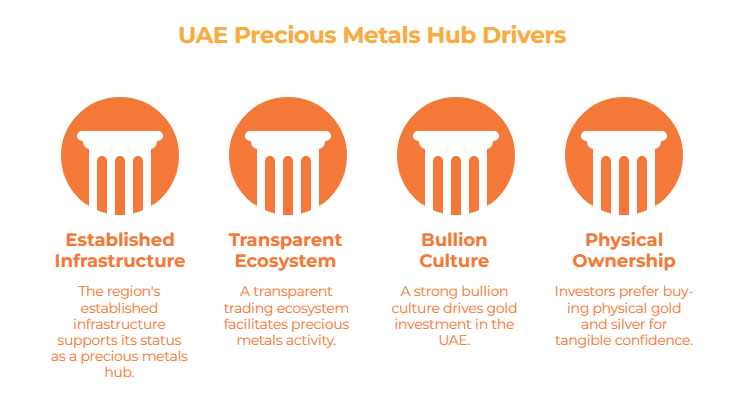
The UAE continues to be one of the world's most important precious metals hubs.
The region's established infrastructure, transparent trading ecosystem, and strong bullion culture have made gold investment UAE a major focus for both local and international investors.
While digital products continue growing, many investors still prefer buying physical gold and silver.
Why? Because physical ownership feels tangible. You can see it. Hold it. Store it. For some investors, that confidence matters just as much as potential returns.
Interest in gold ETFs, gold futures, and silver futures remains strong, but many buyers continue choosing physically backed products and backed gold solutions that offer direct exposure to the underlying metal.
This trend has helped strengthen the region's position in gold and silver bullion trading, particularly among long-term wealth preservation strategies.
Gold has always been in the spotlight but in 2026, silver also is gaining attention.
Unlike gold, silver benefits from significant industrial demand. It's used across electronics, renewable technologies, and manufacturing processes.
One area attracting particular attention is solar panels. As governments invest in clean energy and global energy infrastructure, silver consumption may continue expanding. That creates an additional layer of demand beyond traditional investment buying.
Some analysts believe this dual role could support silver if economic growth remains healthy while investment demand also stays strong.
There is no doubt in the fact that silver can be more volatile than gold. Its price movements tend to be sharper. Its market is smaller. It can feel a bit more riskier compared to gold during uncertain periods.
But that's also part of why many investors are paying closer attention to it in 2026.
No one has a crystal ball. Any expert analysis claiming certainty should probably be approached carefully.
Still, several themes continue appearing in market discussions:
Many analysts view continued demand from central banks as a supportive factor for the gold market. Combined with concerns around global uncertainty, this has helped maintain a generally bullish outlook among some market participants.
The base case scenario for many investors isn't necessarily a dramatic spike in prices. Instead, it's the belief that gold still remains relevant.
Back in 2025, many expected diplomatic efforts and economic recovery to calm markets. Some progress happened. Some challenges remained.
Now in 2026, investors are navigating a different environment.
The commodity market continues to react to geopolitical events, shifting growth forecasts, and evolving policy decisions. Gold demand remains resilient, while silver continues benefiting from industrial trends and investment interest.
Will prices always move higher? Of course not.
Markets fluctuate. Sentiment changes. Headlines create temporary volatility.
But for investors seeking stability amid uncertainty, precious metals remain part of the playbook.
Whether it's gold's reputation as a long-term store of value or silver's expanding role in modern industry, the future of the gold and silver markets in the Middle East looks set to remain one of the most closely watched stories in global investing.
And the recent history has taught that when uncertainty grows, investors rarely stop looking toward gold and silver. If anything, they look even closer.

We are pleased to announce that Ashoka Global’s Mobile Trader application is now available in Play Store and App Store. From this App, you can make the main trading functionalities at your fingertips anytime anywhere using your Android or iOS Device.