
Explore how geopolitical tensions are driving a surge in physical gold trading and boosting investor demand for gold and silver in 2026.

Whenever there are scenes of uncertainty, people start paying closer attention to things that have survived every crisis before them. They look at assets that have been trusted for centuries. This is what is happening in physical gold trading today.
When geopolitical tensions start influencing economies of the world, trade routes, and financial systems, the gold and silver market starts getting attention from institutions and individual investors alike. Every major event leaves a mark on the price and movement of a precious metal, be it war, inflation, or something else. As a result, there is a surge in activity across global markets.
When uncertainty grows, people often turn to assets they can physically hold.
Markets react quickly to headlines. One day it's an election. The next day it's a trade dispute. Then a military conflict emerges.
When tensions rise, financial markets become unpredictable. Stocks fluctuate. Bonds react. Currencies move sharply. That's when many investors start looking for stability.
Historically, a safe-haven asset has offered protection during periods of stress. Gold has repeatedly filled that role. The recent wave of geopolitical tensions has once again strengthened safe-haven demand across multiple regions.
Seasoned investors understand the importance of the balance between preserving and growing wealth. That's why the demand for precious metals remains strong through both economic and political uncertainty.
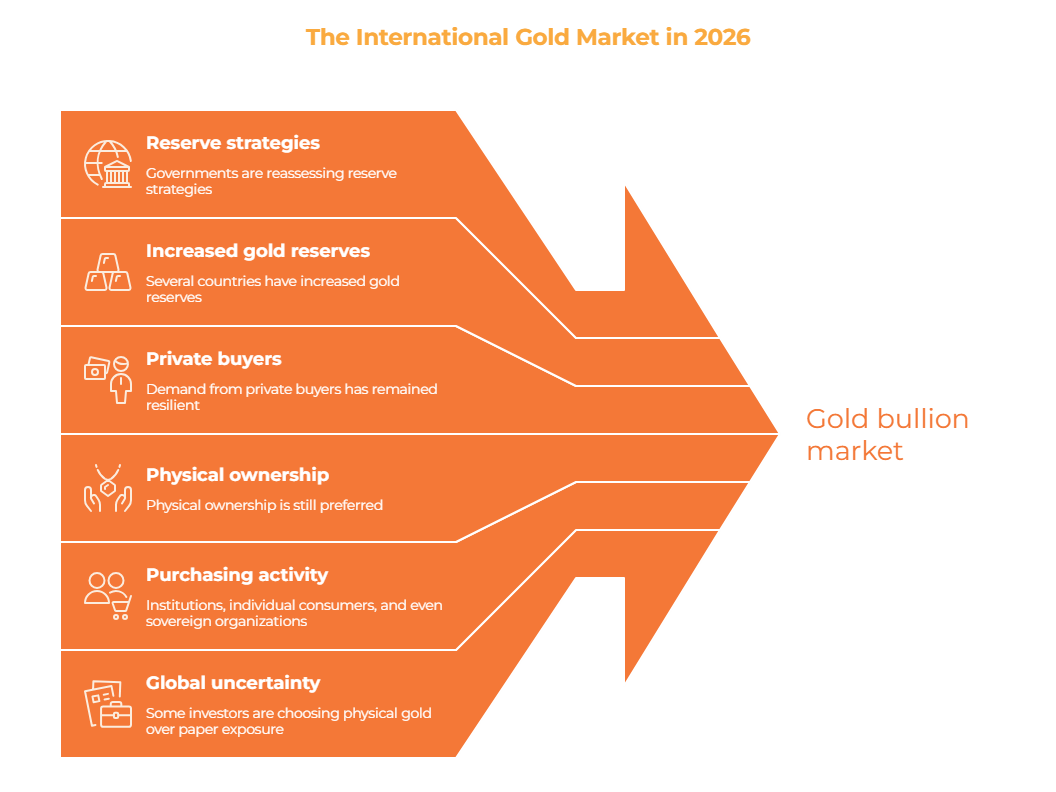
The International gold market today looks very different from what it did a few years ago.
Back in 2022, many economies were still dealing with post-pandemic disruptions. In 2025, there were concerns around restrictions related to trade, regional conflicts, and so on.
Now in 2026, many governments are reassessing reserve strategies. Several countries have increased gold reserves for financial security. At the same time, demand from private buyers has remained resilient.
A recent analyst report noted that physical ownership is still preferred. Because it has no risks unlike digital assets.
Despite all-time high prices, the gold bullion market continues to attract capital
The gold bullion market is getting observed in the metals industry.
Prices have been sustained by robust purchasing activity from institutions, individual consumers, and even sovereign organizations. Some investors are choosing physical gold over paper exposure because of global uncertainty.
Stronger worldwide distribution networks, improved logistics, and enhanced transparency are all helping the gold bullion market. In many regions, buy gold decisions are no longer limited to large investors. Access has become easier and more secure.
A growing number of countries have expanded their holdings of central bank gold. The answer is diversification.
Many nations have shifted from depending only on one currency or a limited group of reserve assets. They are exposed to an asset that has held its worth over centuries by expanding their gold holdings.
Several reports from the World Gold community suggest that there has been continuous purchase from official institutions. This has helped support the broader market.
Even though a central bank purchase might not make news right away, these choices eventually affect supply and demand.
When we talk about precious metals, rates are bound to be discussed.
Investors keep an eye on Jerome Powell, Federal Reserve statements, and monetary policy developments. Expectations around rate cuts affect metal prices. Because lower rates can reduce the opportunity cost of holding non-yielding assets.
This year, spot gold came very close to a record high several times. While futures activity remained active on COMEX.
Traders keeping an eye on the direction of the market focused on the benchmark contract for gold futures for delivery in February.
At times, the gold price moved toward an all-time high level. The reasons being demand by investors and concerns surrounding future economic growth.
When the greenback weakens, many dollar-denominated commodities become more attractive internationally. That relationship continues to influence the market.
Gone are the days when silver used to live in gold's shadow.
The silver market has developed its own story due to its dual roles in the investment and manufacturing industry. Unlike gold, silver benefits heavily from industrial demand.
It's used in a wide range of industries such as consumer electronics, solar, automobile, and so on. Those applications continue to expand. As a result, the demand for silver has remained healthy.
In several regions, silver imports have increased as industries prepare for future production needs. Investors are also showing interest which has helped create momentum.
Recently, silver prices rise became a frequent market headline. Spot silver outperformed expectations in a few sessions. This indicated that silver trend would continue to persist. Many investors are giving silver growing importance rather than being considered after gold.
The metals market doesn't work in isolation. Every major commodity market influences the others in some way.
Platinum, copper, and palladium each respond to different economic drivers. A base metal may benefit from manufacturing growth. While investment metals respond more strongly to uncertainty.
Still, assets like gold are given importance when there is high risk in the market. This is the reason why investors are closely examining their allocation strategies for the coming years.
Some expect precious metals to outperform traditional assets if uncertainty persists.
The next few years could be fascinating.
Political developments in the U.S, Europe, and the Middle Eastern region will likely continue influencing market sentiment. Trade policies introduced by US President Donald Trump are also being closely monitored by market participants involved in international finance.
At the same time, questions about inflation, debt levels, and potential debasement concerns remain part of the conversation.
Many investors are also paying attention to the relationship between fiat currencies and hard assets. The appeal of gold-backed products continues to grow. Certain market analysts are becoming more critical of traditional treasury products.
The shifting economic landscape creates opportunities, but it also creates uncertainties. That's where discipline matters.
Though technology has transformed investing, physical ownership continues to hold a special place.
A tangible asset gives you reassurance. As it is stored in a secure depository rather than relying entirely on financial intermediaries. For many buyers, removing an unnecessary intermediary adds confidence.
Whether someone is purchasing a single bar or a tonne of metal, trust remains essential. That is particularly true when sourcing gold and silver bullion from reputable suppliers operating within the LBMA ecosystem.
Many buyers today choose to buy gold and silver bullion online through trusted channels that offer secure sourcing and clear documentation.
As market volatility continues and the gold and silver sector adapts to changing realities, one thing seems clear. The role of the yellow metal and its counterparts isn't fading.
If anything, the combination of economic pressure, political uncertainty, rising demand, and evolving investor behavior may provide another boost to the sector in the coming years. From India’s growing appetite for metals to institutional interest in the gold and silver bullion trade, the story is still unfolding.
And judging by recent activity across the gold bullion market, many remain firmly bullish on where that story goes next.

We are pleased to announce that Ashoka Global’s Mobile Trader application is now available in Play Store and App Store. From this App, you can make the main trading functionalities at your fingertips anytime anywhere using your Android or iOS Device.