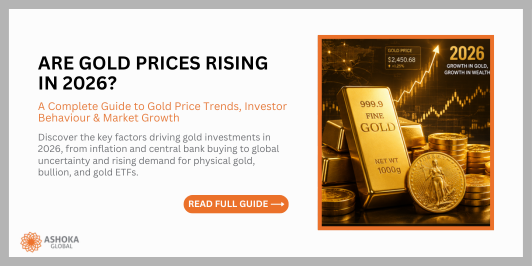
Why is gold investment rising in 2026? Check out the trends, insights, and market signals shaping global demand for precious metals this year.

Something interesting has been happening in the gold market lately. Not quietly either.
From central bank purchases to retail investors buying smaller quantities every month, the conversation around gold investment in 2026 feels different this time. Less emotional panic-buying. More calculated positioning. People no longer react to whatever is happening in the market; they are preparing themselves for the future.
And if you’ve been following the gold market trend, you’ve probably noticed the same thing. Gold isn’t being treated like an “old-school asset” anymore. It’s back in serious financial conversations. Fund managers are discussing allocation percentages again. Investors are rethinking their decisions about how much of their hard-earned money should be allocated where. Surprisingly, young investors too are giving gold the due importance.
The current gold market trend reflects something deeper than short-term speculation. It reflects uncertainty and human instinct. Across countries, global gold investments are increasing because people still trust what gold has represented for centuries, stability when everything else feels shaky.
And honestly? 2026 has given investors enough reasons to feel cautious.
If you only look at charts, you’ll see numbers moving upward. But behind those numbers is emotion. Fear of inflation. Concerns around interest rates. Geopolitical tensions that don’t seem to settle for too long. The gold price trend in 2026 isn’t happening in isolation.
Over the last year, investors have watched economies slow down while living costs stayed stubbornly high. Central banks across the world tried balancing inflation control with economic growth, and somewhere in between, confidence in traditional markets became fragile. That’s usually where gold enters the room.
People don’t suddenly wake up wanting gold bars in a vault. It happens slowly. A few investors move funds from equities into precious metals. Then institutional investors increase exposure through gold ETFs. Then families start asking whether keeping all savings tied to currency and stock markets is really wise anymore. Before long, the demand for gold starts climbing. And that demand pushes gold prices in 2026 even further.
There’s a reason gold has survived every financial era. Tech evolves. Currencies fluctuate. Entire industries disappear. Yet gold continues to hold psychological weight, unlike almost any other asset class. It’s not just about returns.
Gold is still seen as a store of value. That phrase gets repeated often in finance circles, but you really understand it during uncertain periods. When the situation of inflation arises or there is geopolitical unrest, investors become cautious. They start looking for traditional forms of investments. That’s why many consider gold a safe investment during unstable economic cycles.
This part matters more than many people realize. Retail investors often follow trends after institutions move first. And right now, central bank activity in the gold market is hard to ignore.
Several central banks have significantly increased their gold holdings over the past few years. Why? Partly to diversify reserves away from overdependence on certain currencies. Partly as protection against long-term geopolitical and economic risks.
When central banks accumulate gold consistently, it sends a signal. Not a loud one. But an important one. It tells investors that even governments and financial institutions still value gold during periods of uncertainty. And when institutional confidence aligns with rising retail interest, the momentum in the gold market becomes stronger. That’s one reason many analysts expect higher gold prices through different phases of 2026.
The interesting thing about current gold investment trends is that they don’t all look the same. Some investors are buying physical bullion. Others prefer digital gold platforms. Younger investors often enter through gold ETFs because they’re easier to access and trade. Wealth managers, meanwhile, are adjusting portfolio allocations to include a slightly higher percentage of precious metals than they did a few years ago.
What’s also noticeable is how global gold investments are becoming more diversified geographically. Even though demand is no longer region-specific. Investors from across the world are putting efforts to increase their exposure despite inflation and recession.
And unlike previous gold rallies driven mostly by panic, today’s gold investment trends feel more strategic. Investors are thinking long term.
They’re asking practical questions:
Gold naturally enters those conversations.
Interest rates have always influenced the gold market in complicated ways. Traditionally, when interest rates rise, gold can lose some appeal because investors shift toward income-generating assets. But 2026 hasn’t followed every traditional rule perfectly.
Why?
The reason being inflation makes both people and investors emotionally drained.
No doubt, inflation has become cold, decreasing the costs of essential items like groceries, household items, and so on, but people still find it difficult to manage expenses. Gold benefits from that uncertainty.
And if central banks begin easing interest rates later in 2026 to support slowing economies, gold investment demand could strengthen even more. Lower rates often reduce the opportunity cost of holding non-yielding assets like gold. That’s why many forecasts remain optimistic about the gold price outlook this year. Not because gold is magically immune to volatility. It isn’t. But because the environment surrounding global markets continues to support demand for safer assets.
This may sound strange, but some of the strongest drivers of the gold market are things investors wish weren’t happening at all. Wars. Trade disputes. Currency instability. Elections. Diplomatic tensions. Geopolitical uncertainty creates emotional reactions in financial markets very quickly. Investors start looking for protection before they fully understand the long-term consequences.
Gold has historically benefited during these periods because it’s globally recognized and relatively independent from the performance of any single government or economy. And 2026 has already seen enough geopolitical friction to keep investors cautious. Even experienced investors who usually focus heavily on equities are diversifying more carefully now. Some are increasing gold holdings modestly. Others are moving more aggressively into precious metals altogether.
There’s no single “correct” way to approach gold investment anymore. Some investors still prefer physical ownership, such as coins, bars, or bullion stored securely over time. There’s a certain emotional reassurance in tangible assets that digital investments can’t replicate.
Others prefer liquidity and convenience through gold ETFs. They’re easier to buy, easier to sell, and integrate smoothly into broader investment strategies. Interestingly, many investors are doing both. Physical gold for long-term wealth preservation. ETFs for flexibility and market participation.
And for those looking to expand globally, many are exploring trusted platforms where they can buy gold bullion internationally while diversifying storage and access options. That growing accessibility is also reshaping the gold market. Investing in gold no longer feels complicated or limited to wealthy buyers. Even small investors can participate meaningfully now.
Financial experts usually focus on numbers. Charts. Forecasts. Technical analysis. But gold investing has always carried an emotional layer too.
There’s comfort in owning something with centuries of perceived value. Something that has survived recessions, banking crises, inflation cycles, and currency collapses. People may not always say it openly, but gold often represents peace of mind more than profit maximization. And in uncertain times, peace of mind becomes valuable.
That’s partly why the demand for gold keeps growing despite changing market conditions. Investors aren’t necessarily expecting overnight gains. Many simply want stability within unpredictable financial environments.
It is impossible to predict what will happen in the future.
Yet, some factors can make the prediction go in a positive direction.
There is still a good chance that gold prices will rise if these patterns persist.
Of course, short-term corrections will happen. Gold markets rarely move in straight lines. Some months may feel disappointing. Others surprisingly strong. That’s normal.
But zooming out a little, the broader picture becomes clearer. Investors across the world are not increasing gold investment randomly. They’re responding to a world that feels economically and politically less predictable than it did a decade ago. And when uncertainty rises, gold tends to matter again.

We are pleased to announce that Ashoka Global’s Mobile Trader application is now available in Play Store and App Store. From this App, you can make the main trading functionalities at your fingertips anytime anywhere using your Android or iOS Device.